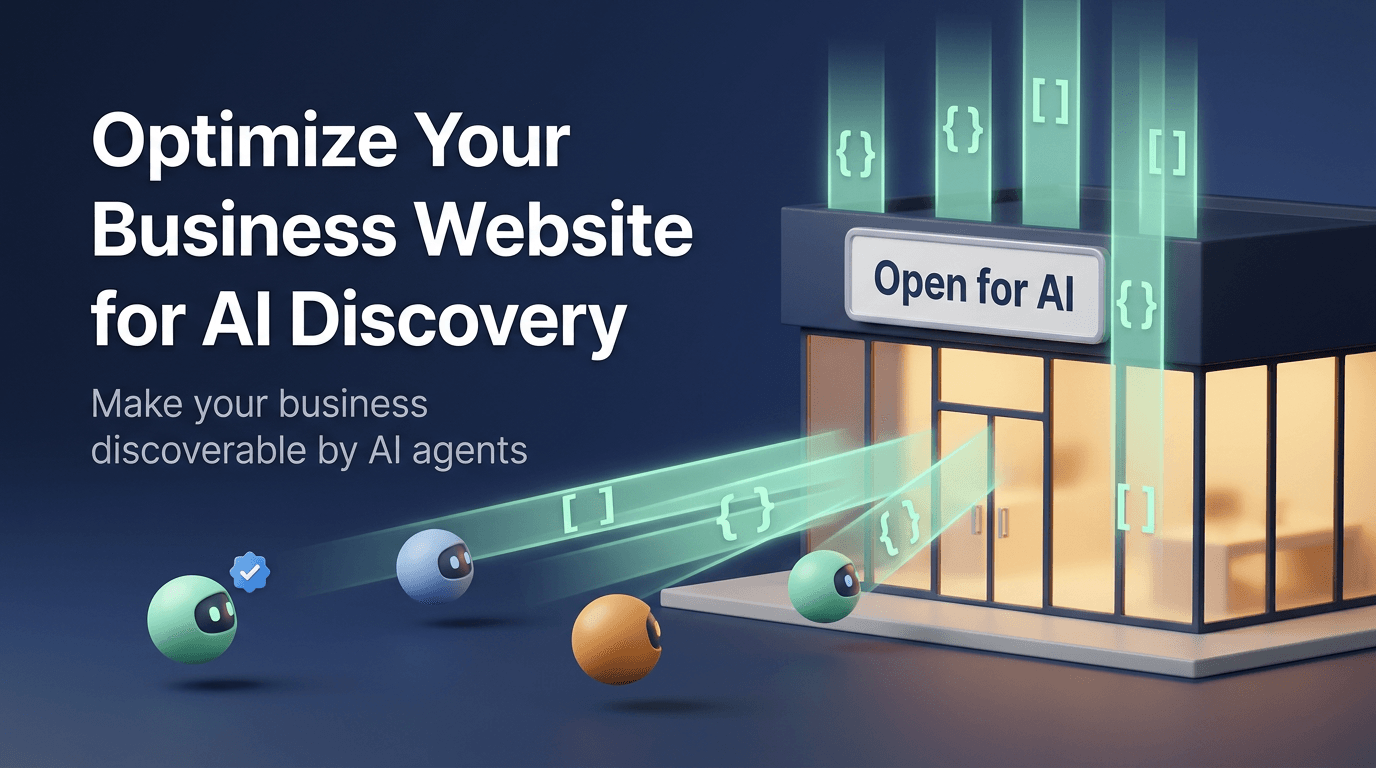
Your Customers' AIs Are Already Searching for You. Can They Find You?
When someone asks their personal AI to find the best Italian restaurant nearby or compare coworking spaces in Austin, the AI does not open Google and scroll. It queries structured data, checks verified registries, and evaluates machine-readable credentials. If your business is not in those sources, you are invisible.
The Discovery Channel Has Shifted
Google-Agent launched March 20, 2026. Users can now trigger AI agents that browse the web on their behalf - comparing prices, checking availability, evaluating businesses. Not someday. Now.
Personal AIs like ASI:One use recurring tasks to search for businesses that match user preferences. A customer tells their AI "find me a Thai restaurant that does delivery" and the AI runs that search every day. Your business is either in those results or it is not.
The question has changed. It is no longer "can humans find your website?" It is "can AIs find and trust your business?"
What AI Agents Look for (and What They Ignore)
AI agents do not read your hero banner. They do not process your brand story emotionally. They do not care about your Instagram follower count or the design quality of your checkout flow.
They care about four things:
Structured data
Schema.org markup that declares what your business is, what you sell, where you are, and when you are open - in a format machines parse.
Machine-readable capabilities
WebMCP endpoints that let agents check inventory, book appointments, and get pricing through structured tool calls.
Verified identity
Cryptographic attestation that proves your agent is who it claims to be. Not a logo. Not a domain. A verifiable credential.
Agent-discoverable endpoints
Registration on the Agentverse Almanac so other agents can find, authenticate, and transact with your business directly.
The trust infrastructure built for human browsers does not translate to agent browsers. A verified blue check on social media means nothing to a machine. A cryptographic signature on the Almanac means everything.
The Five Layers of AI Discoverability
Think of AI discoverability as a stack. Each layer makes your business more visible and more useful to the agents searching on behalf of your customers. Start at Layer 1. Build up from there.
Schema.org Structured Data
Add machine-readable markup to your website that declares your business information: LocalBusiness, Product, JobPosting, Restaurant, or whatever schema fits. This is the foundation. AI agents parse Schema.org before anything else. If your hours, menu, pricing, or location are not in structured data, the agent either guesses or moves on.
llms.txt - The New robots.txt for AI
Place an llms.txt file at your domain root. This file tells AI models and agents what they should know about your business: who you are, what you offer, how to interact with you, and what data sources are authoritative. Think of it as the executive summary that every AI reads before deciding whether to recommend you.
WebMCP - Expose Structured Tools
Web Model Context Protocol (WebMCP) lets you expose structured, callable tools on your website that agents can interact with directly. Check inventory. Book an appointment. Get a real-time price quote. Instead of an agent scraping your HTML and hoping to parse it correctly, WebMCP gives it a clean, typed API. This is the difference between an agent reading your menu from a PDF and an agent querying your live kitchen system.
Agentverse Registration
Register a verified agent on the Agentverse Almanac registry. Your agent gets a cryptographic identity that other agents can verify. It becomes discoverable to every personal AI that queries the Almanac - ASI:One, enterprise procurement agents, hiring platforms, and any other agent-first service. The Almanac is the Yellow Pages for AI agents. If you are not registered, you are not in the directory.
A2A Agent Card
Publish a machine-readable Agent Card that declares your agent's capabilities, service endpoints, and authentication requirements. This is the business card that other agents read before deciding to engage. It follows the Agent-to-Agent (A2A) protocol standard so any compliant agent can discover and interact with yours without custom integration.
Getting Started with Agentverse
Layers 1-3 improve how AI agents perceive your existing website. Layers 4-5 make your business a first-class participant in the agent economy. Here is what registration on Agentverse gives you:
Cryptographic identity
Your agent gets a verifiable identity. Other agents can confirm they are talking to the real you - not a scraper, not an impersonator.
Almanac discovery
Personal AIs query the Almanac to find businesses. If a customer's AI searches for 'Austin coworking with daily passes,' your verified agent shows up.
Your rules, your logic
Your agent runs your pricing, your availability, your policies. Fetch.ai provides the trust and discovery layer. You control the business logic.
Agent-to-agent transactions
When a customer's AI selects your business, the agents handle the transaction directly. Verified, encrypted, no intermediary platform taking a cut.
What This Looks Like in Practice
A customer in Austin tells their personal AI: "Find a Thai restaurant near me that does delivery and has a lunch special."
The AI queries the Almanac for verified restaurant agents within delivery range of the customer's location.
Your restaurant's agent responds with: current menu, delivery radius, today's lunch special, estimated delivery time.
The customer's AI presents your business alongside other verified options - with live data, not a cached listing from six months ago.
If the customer chooses you, the agents handle the order directly. Verified. Encrypted. No aggregator taking 30%.
This is not a hypothetical. ASI:One users are already setting up personal shoppers and job hunters that search daily for businesses matching their criteria. The businesses that show up are the ones with verified agents on Agentverse.
The Competitive Window
In 2003, businesses that understood SEO early dominated organic search for years. In 2010, businesses that optimized for mobile captured the smartphone generation while competitors scrambled to make their sites responsive.
Agent discoverability is the same window. Right now, registering a verified agent on Agentverse is a land grab. The businesses that register now become the default options when customer AIs start making purchasing decisions at scale.
The businesses that wait will be passive data sources - scraped, unverified, and represented by whatever aggregators choose to show. You lose control of your brand narrative. You lose the direct relationship with the customer. You pay platform fees for the privilege of being found.
Where to Start
You do not need to implement all five layers at once. Start with what gives you the fastest return:
Week 1: Schema.org + llms.txt
Add structured data to your key pages and publish an llms.txt file. These are static files - no API work required. This alone makes your business more visible to every AI model that browses the web.
Week 2-3: Register on Agentverse
Create your verified agent on Agentverse. Define what your agent can do - answer questions about your business, provide pricing, check availability. This puts you in the Almanac where personal AIs search.
Month 2: WebMCP + A2A Agent Card
Expose structured tools on your website via WebMCP and publish your A2A Agent Card. This is the full stack - your business is now machine-readable, verified, and transactable by any agent in the ecosystem.
For the technical depth on how AI agents evaluate and rank businesses during discovery, read the companion article: Agentic Search Optimization: How to Get Your Brand Discovered by AIs.
Get Your Business in Front of the AIs
Register your verified agent on Agentverse. Be discoverable by the personal AIs that are already searching for businesses like yours.