From Factory Floor to Checkout: Why Manufacturing Needs Verified Agent Identity Under the EU AI Act
The EU AI Act's transparency obligations do not stop at the retail counter. Manufacturing, supply chain orchestration, and production operations are deploying multi-agent systems that interact with people across the value chain - and every one of those systems falls within regulatory scope.
In the first two pieces of this series, we examined how the EU AI Act's Article 50 transparency obligations affect retailers building agentic commerce, and how multi-agent ecosystems create compliance challenges that go beyond any single agent. The picture we drew was consumer-facing: brand agents, payment agents, customer service agents - the front line of agentic commerce.
But the value chain does not start at the checkout. Manufacturing, production, quality assurance, supply chain logistics, and procurement are all domains where AI agents are being deployed at accelerating rates. And the EU AI Act does not draw a line between consumer-facing and operational AI. The Article 50(1) transparency obligation applies wherever an AI system directly interacts with a natural person - and in manufacturing, that interaction surface extends beyond the customer to include factory workers, warehouse managers, and supplier contacts who engage directly with AI systems.
Where AI Agents Operate in Manufacturing
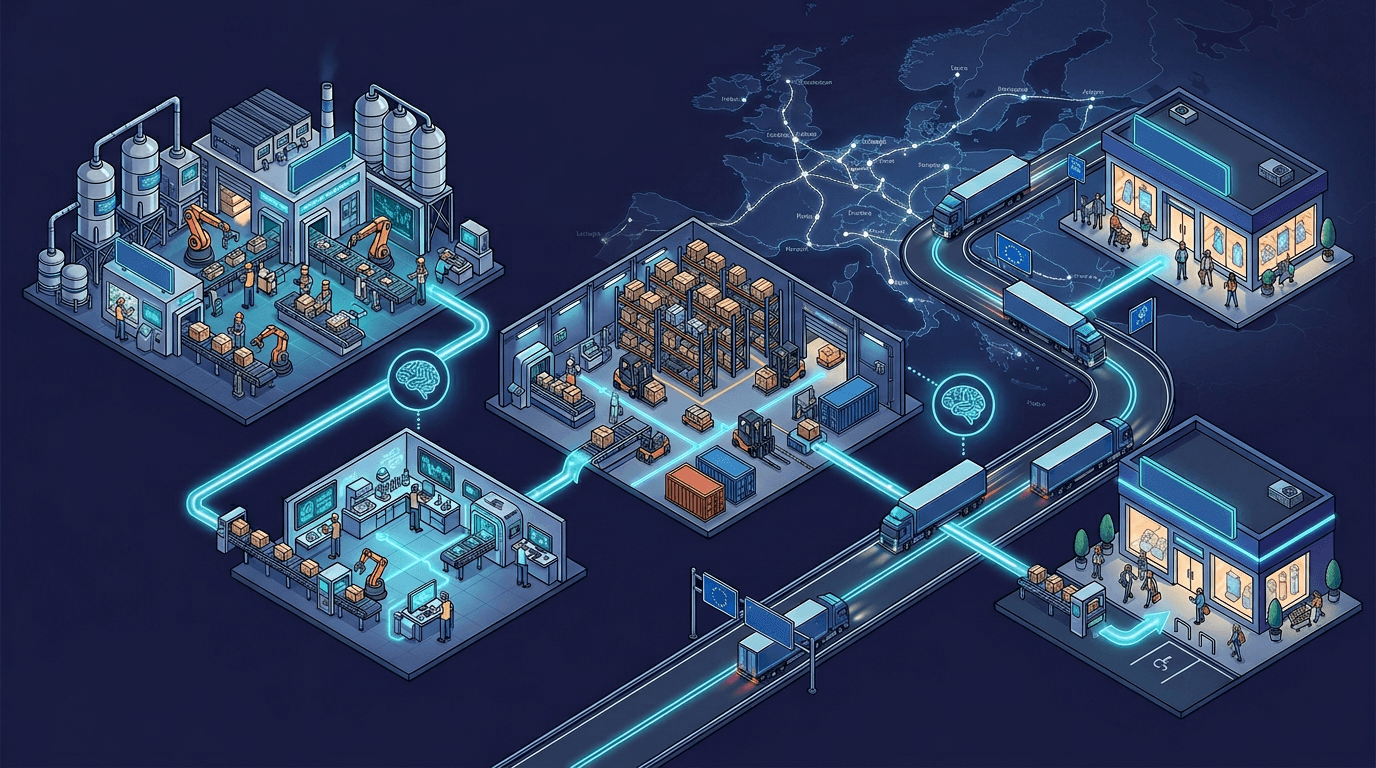
A modern manufacturing operation may deploy AI agents across the entire value chain. Each one represents a potential compliance surface under Article 50:
Production planning agents
AI systems that schedule production runs, allocate resources, and optimise line efficiency. When these agents generate work orders that factory floor workers follow, the worker is a natural person receiving instructions from an AI system.
Quality control agents
AI systems that inspect products, flag defects, and approve or reject batches. When a quality agent communicates a rejection decision directly to a production line supervisor through a conversational interface or real-time alert system, it is directly interacting with a natural person under Article 50(1). AI-generated inspection reports consumed by human inspectors may also trigger Article 50(2) content marking obligations.
Supply chain orchestration agents
AI systems that coordinate with supplier agents, logistics providers, and warehouse management systems. When a supply chain agent sends a delivery schedule to a warehouse manager, or when it negotiates terms with a supplier's procurement team, the interaction touches people.
Procurement agents
AI systems that evaluate suppliers, compare quotes, and initiate purchase orders. When a procurement agent communicates with a supplier's sales team - even through another agent - the chain of interaction eventually reaches a natural person.

The Cross-Border Dimension
Manufacturing supply chains rarely stay within a single jurisdiction. A UK-based retailer may source components from a German manufacturer, whose supply chain includes a Polish logistics provider and a Czech raw materials supplier. Each organisation may deploy AI agents that interact with people at the other organisations.
The EU AI Act applies to AI systems placed on the market or put into service in the EU, and to systems whose output is used in the EU - regardless of where the provider is located. A supplier's AI agent in Turkey that generates delivery estimates consumed by a logistics manager in Germany falls within scope.
Extraterritorial scope
The EU AI Act applies to non-EU providers if their AI systems are used in the EU or generate output consumed in the EU. A manufacturing supply chain that spans multiple countries creates a compliance surface that extends across every jurisdiction in the chain.
Agent identity must cross borders
When a supplier's procurement agent in one country interacts with a buyer's agent in another, both agents need verifiable identity that is interoperable across jurisdictions. National identity schemes are insufficient. The verification must work at the protocol level, independent of geography.
What Manufacturing Organisations Need
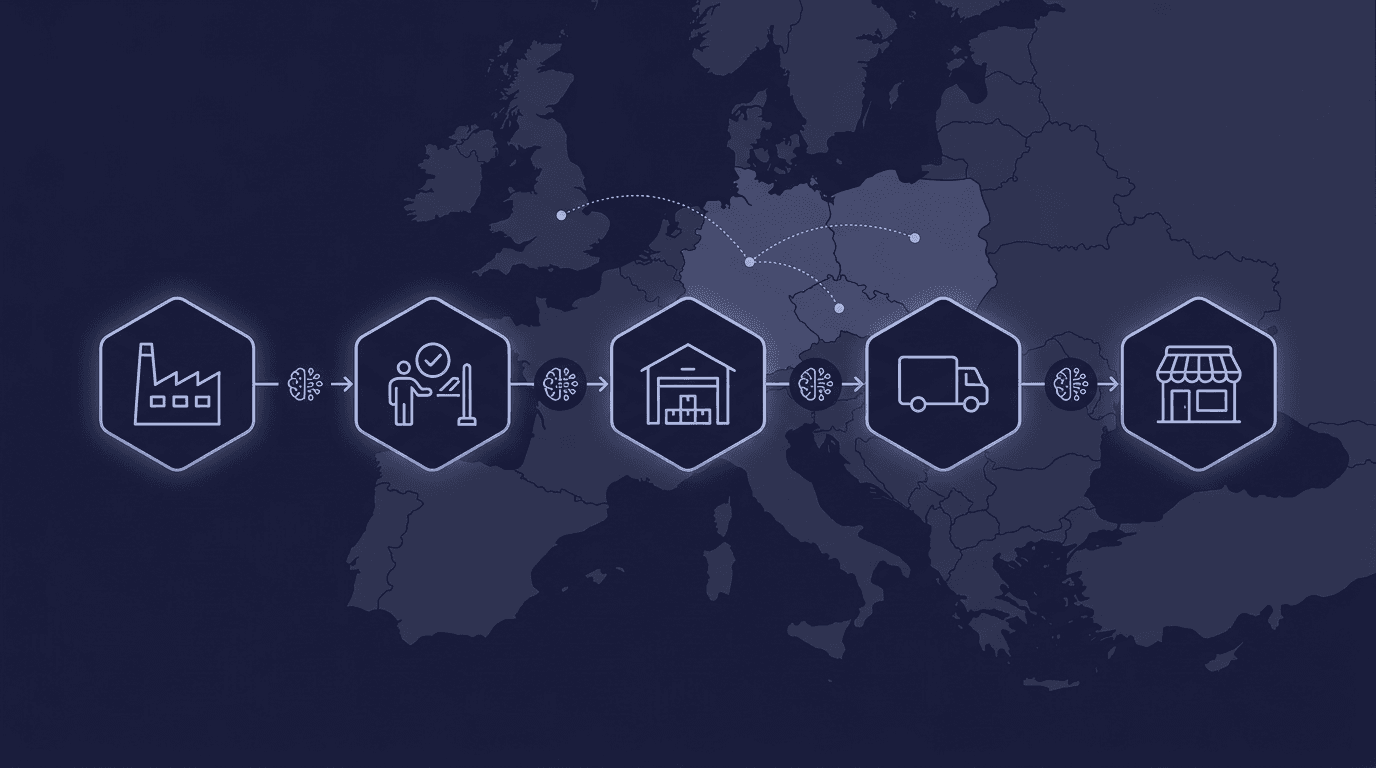
The requirements for manufacturing and supply chain compliance mirror and extend the retail requirements we described in the previous article. But the scale is different. A retailer's agent ecosystem might involve five or six agents in a consumer workflow. A manufacturing supply chain might involve dozens of agents across production, quality, logistics, procurement, and customer delivery - spanning multiple organisations and jurisdictions.
Verified identity for every agent in the supply chain
Every AI agent - whether it schedules production, inspects quality, coordinates logistics, or negotiates with suppliers - must carry a verifiable identity. The identity must be interoperable across organisations and jurisdictions.
Ecosystem-level orchestration with compliance built in
Multi-agent manufacturing workflows need orchestration where every participating agent is identifiable. When a production planning agent generates a work order, the receiving system must be able to verify which agent created it and which organisation it acts for - not through self-reported labels, but through cryptographically verifiable identity.
Cross-organisational audit trails
A regulator investigating a supply chain compliance question will not accept audit trails that stop at organisational boundaries. The trail must follow the agent interaction across every organisation in the chain, with verifiable agent identity at each step.
Proportional compliance across risk levels
The EU AI Act categorises AI systems by risk level. A quality control agent that affects product safety may be classified as high-risk, carrying additional obligations. Organisations need infrastructure that supports different compliance levels across the agent ecosystem.
How Verified Agent Infrastructure Scales to Manufacturing
The fundamental problem in manufacturing supply chain compliance is the same as in retail, but the scale is worse. A typical manufacturing supply chain involves dozens of organisations across multiple countries. A German manufacturer's quality agent has an internal identifier that means nothing to the Polish logistics provider, the Czech raw materials supplier, or the UK retailer receiving the finished goods. Without a shared registry, verifying each agent requires a bilateral agreement per connection. In a supply chain with 15 organisations, that is up to 105 bilateral trust relationships to establish and maintain - each with its own authentication mechanism, its own credential format, its own compliance exposure.
Fetch AI's Almanac eliminates this scaling problem entirely. Every agent in the supply chain - regardless of the organisation that operates it, the country it operates in, or the technology stack it runs on - registers on the same neutral, on-chain registry with the same cryptographic identity standard. A German quality agent and a Polish logistics agent verify each other through one Almanac lookup, not a bilateral integration. Add a new Turkish supplier to the chain, and their agents are verifiable instantly - one registration, not 15 new trust agreements. The identity layer scales linearly with participants, not exponentially with connections.
One identity standard across the value chain
A production planning agent in a German factory and a logistics agent in a Polish warehouse register on the same Almanac. When they interact, each verifies the other's identity automatically. No bilateral trust agreements. No manual credential exchanges. One protocol, interoperable everywhere.
Agent identity is verifiable at every interaction point
When a quality control agent flags a defect and sends a report to a human inspector, the agent's identity is verifiable via the Almanac. The inspector's system can confirm which agent generated the report, which organisation registered it, and whether it is a known, authenticated participant in the ecosystem. This is the foundation for building compliance records that are attributable rather than anonymous.
A shared identity layer that crosses organisational boundaries
The hardest part of cross-boundary compliance is that each organisation in the chain has its own identity system. The Almanac solves this by providing a single, neutral registry that all parties use. A regulator following an interaction from a consumer's AI assistant through a retailer's brand agent, a manufacturer's production agent, and a supplier's logistics agent can verify each participant's identity against the same on-chain registry - regardless of which organisation operates the agent.
The Converging Pressure
Manufacturing organisations face converging pressure from two directions. Downstream, consumer-facing retailers are beginning to require verified agent identity from their supply chain partners as a condition of doing business - because the retailer's own EU AI Act compliance depends on knowing who participated in the agent chain, and unverifiable suppliers are a liability. Upstream, regulators are beginning to treat supply chain AI visibility as a systemic requirement, not an individual one. The manufacturer sits in the middle, facing demands from both sides.
This creates a clear first-mover dynamic. The manufacturer that registers its agents on the Almanac now becomes the trusted node in the supply chain - the one retailers prefer because its agents are verifiable, the one regulators can audit without friction. The manufacturer that waits finds its retail customers already aligned with competitors who registered first. In a supply chain where trust is the entry requirement, late registration is not just a compliance risk - it is a commercial disadvantage. You do not lose the contract because your product is worse. You lose it because your agents cannot be verified.
Verified agent identity across your supply chain
15 supply chain partners means 105 bilateral trust relationships - or one Almanac registration each. From production planning to final delivery, one identity standard across every organisation and jurisdiction. The manufacturers that register first become the trusted nodes their retail customers prefer.
Joe Hurst - Chief Revenue Officer
Joe.Hurst@fetch.ai